A four-layer control plane between legacy systems and execution rails.
The ZenithBloxTM platform is a policy enforcement runtime. It is workflow-modelled, rulebook-evaluated, system-connected, and rail-agnostic. Every governed transaction is decided before any execution environment is invoked. The result is a verifiable decision artefact — ALLOW, DENY, or REQUIRE APPROVAL, each reported with its reason — that becomes the institution's primary governance evidence.
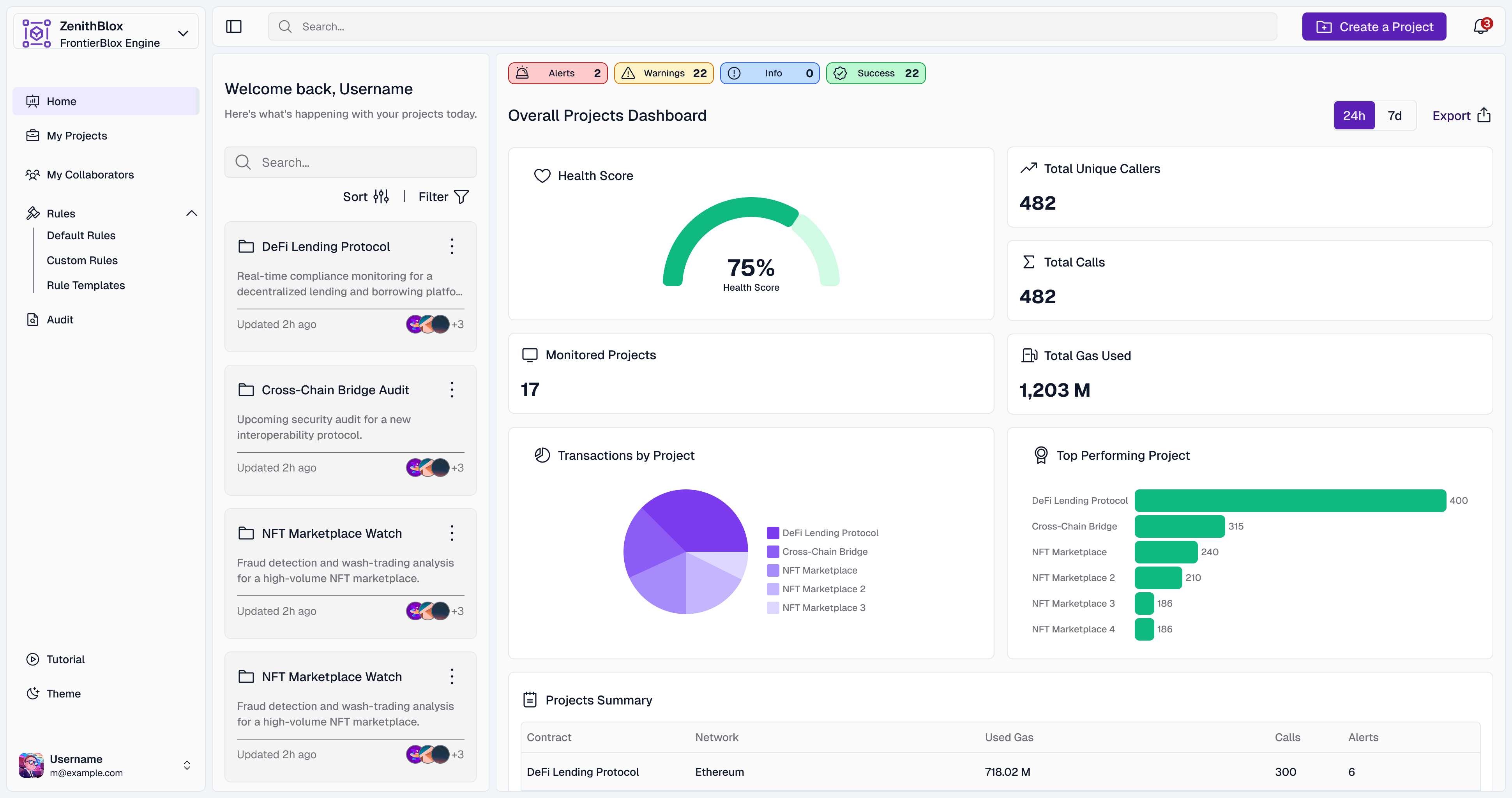
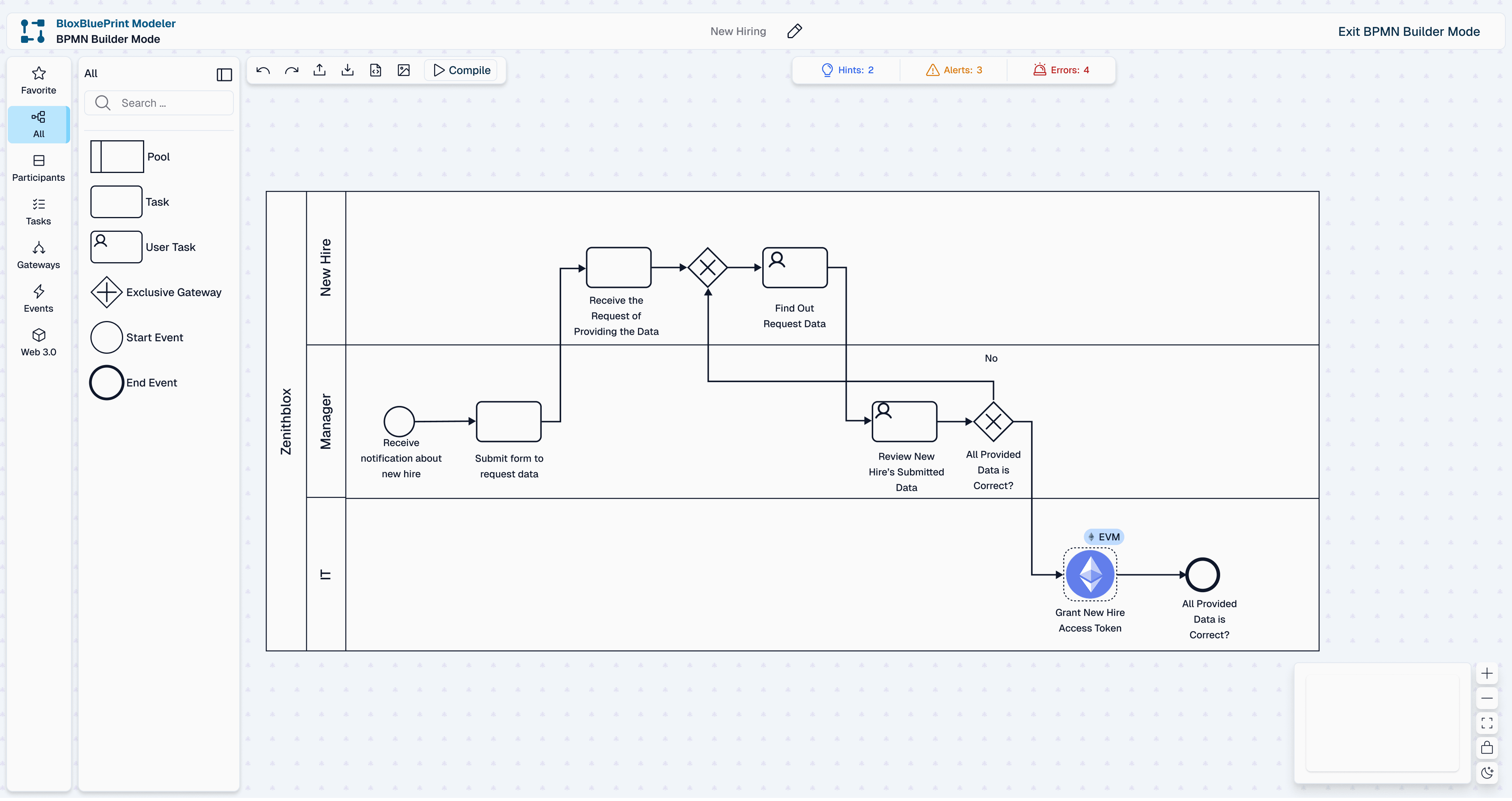
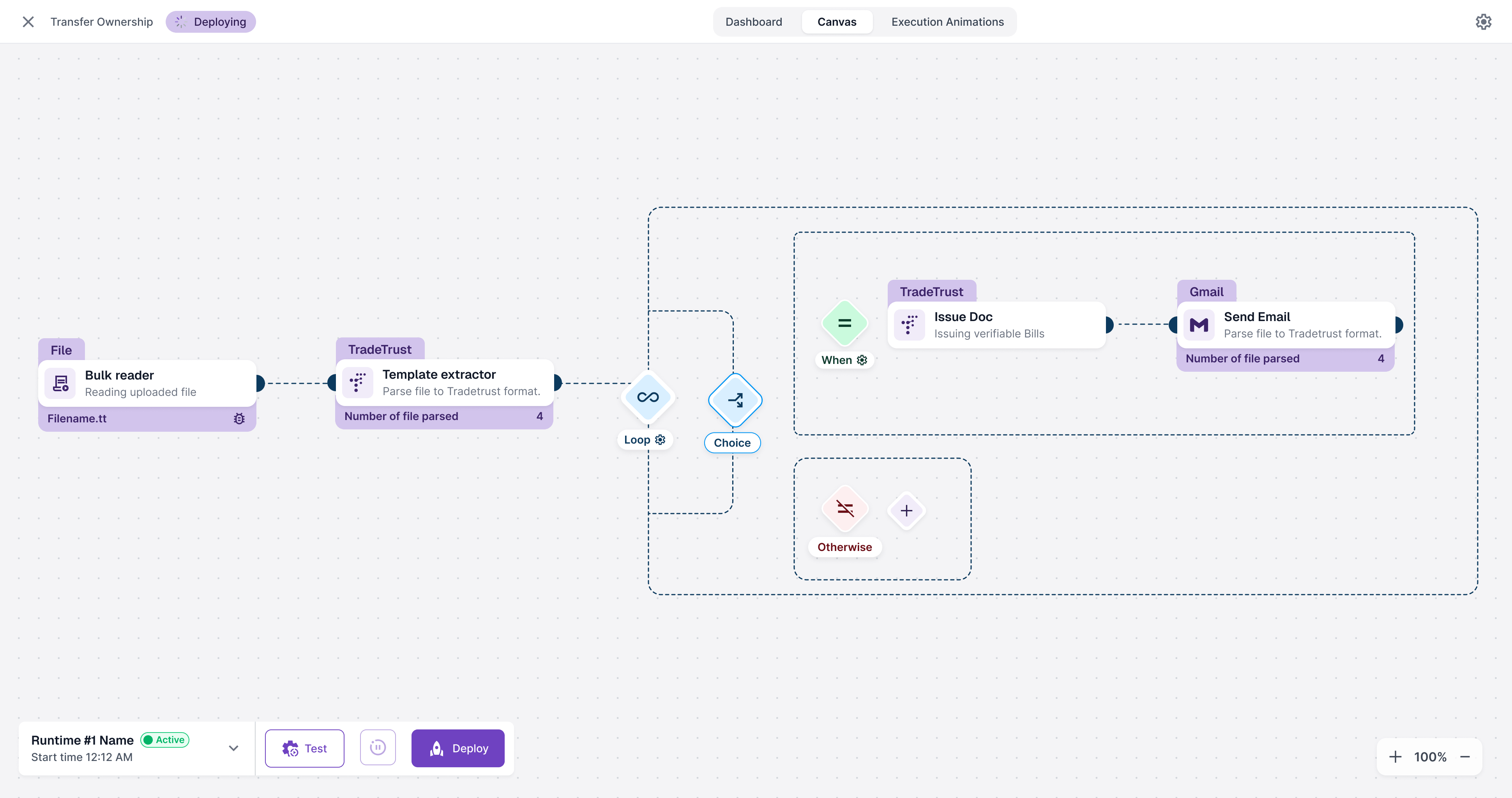
Process. Policy.
Orchestration. Execution.


Process
Models the workflow
Workflows are expressed in BPMN. The same definition reviewed by compliance is the one the runtime evaluates — closing the gap between policy as authored and policy as executed. The BPSC Compiler translates approved process models into auditable execution artefacts.

Policy
Decides the transaction
Real-time evaluation against the active rulebook produces a deterministic decision — ALLOW, DENY, or REQUIRE APPROVAL — reported with its reason, timestamped, rule-linked, and configured for signed evidence.

Orchestration
Connects across the boundary
Bidirectional adapters move structured information across the workflow boundary. Information moves across the boundary — authority does not.
Rails
Public & permissioned rails
Stablecoin · Payment · CBDC
Execution
Settles after authorisation
The rail receives the instruction only after authorisation and executes it. It does not decide. Without a reported ALLOW, the configured workflow does not submit the instruction.
One control plane. Four components. Each with a defined verb.
Each platform component does one thing and produces one kind of evidence. The boundaries are precise because the audit trail must be unambiguous.
BloxBlueprint
BPMN-based visual modelling for regulated workflows. Compliance and business teams author the workflow definitions that the runtime evaluates. Designed for the people who own the policy — not for developers.
- BPMN 2.0 process modelling with Web3 constructs
- Versioned workflow definitions with maker-checker authoring
- Workflow definitions as the source of governed execution logic
- Reviewed by compliance · audited by supervisors · executed by the runtime
BPSC Compiler
Business-Process-to-Smart-Contract compiler. Approved BPMN workflows are translated into auditable execution artefacts that the regulator and supervised institution can both review.
- BPMN → executable artefacts with traceable provenance
- Auditor- and regulator-reviewable output
- Versioned, signed, and bound to the originating workflow
- Eliminates the gap between authored policy and deployed contract
FrontierBlox Engine
The pre-execution decision engine. Evaluates every transaction request against the active rulebook in force and reports a verifiable decision and its reason. Real-time, deterministic, fail-closed for the configured workflow.
- ALLOW · DENY · REQUIRE APPROVAL decisions, each reported with its reason, timestamped and rule-linked
- Configured for signed evidence where required (EdDSA / Ed25519)
- Decision objects cryptographically bound to transaction intent
- Fail-closed: without a reported ALLOW, the configured workflow does not submit the instruction
Universal Adapters
Bidirectional connectors between institutional systems and programmable execution rails. Information moves across the workflow boundary. Authority does not.
- Institutional: SWIFT, core banking, ERP, treasury, AML/KYC, custody
- Rails: public & permissioned chains, stablecoin, payment, CBDC
- Pre-built corridor connectors for trade-finance and settlement workflows
- Structured attributes only — full customer records remain inside the institution
The control plane sits at the workflow boundary.
Compliance ownership stays with the institution. Custody stays with the custodian. What changes is a single pre-execution evaluation step — where one previously did not exist.
Institutional Systems
BloxBlueprint · BPSC Compiler
Workflow modelling
FrontierBlox Engine
Pre-execution decisions
Universal Adapters
Cross-boundary connectors
Decision Artefact
Execution Rails
Institutional Systems
BloxBlueprint · BPSC Compiler
Workflow modelling
FrontierBlox Engine
Pre-execution decisions
Universal Adapters
Cross-boundary connectors
Decision Artefact
Execution Rails
A transaction request expressed in a structured form — counterparty identifiers, instrument details, amounts, jurisdiction, requesting user, and the contextual data needed to evaluate the institution's rulebook. Full customer records remain inside the institution.
A verifiable decision — ALLOW, DENY, or REQUIRE APPROVAL — reported with its reason and linked to the specific rule applied, the policy version in force, and the decision timestamp. Configured for cryptographic signing where required.
A valid authorization, the wallet or account boundary information needed to act on it, and the cryptographic evidence the rail requires. The rail receives an authorization — not the institution's underlying compliance state.
The decision artefact, the rulebook version, the policy version, the input data hash, and the linked rule. These are the artefacts that supervisors and internal audit will request.
Adjacent categories exist at adjacent layers — none of them sit where the authorization decision needs to be made.
Architectural position determines what a category can and cannot prevent. Monitoring sits after execution. Custody-tied controls sit at the custodian boundary. Smart-contract frameworks sit inside the execution environment. The control plane sits between the institution's compliance function and the execution rail — and that is the layer where pre-execution governance is possible.
Sits after execution. Observes what has already happened. Cannot prevent a non-compliant settlement. Useful for forensic reconstruction; insufficient for fail-closed posture.
Sits at the custodian boundary. Applies rules within a custody account. Does not generalise to multi-custodian, multi-chain, multi-counterparty, or documentary workflows. Compliance scope ends where custody ends.
Sit inside the execution environment. Encode policy as contract code. Authority transfers from the institution to the contract author at deployment. Regulator review requires reading the contract.
Sit at the settlement layer. Provide controlled execution environments. Do not author policy decisions. Coexist with the control plane as one possible execution rail.
Sits before execution. Evaluates each request against institutional and regulatory policy at the workflow boundary. Produces verifiable decision evidence linked to a specific rule version. Fail-closed for the configured workflow. Custody-agnostic. Rail-agnostic. The layer where pre-execution governance is architecturally possible.
Workflow-by-workflow, not core replacement.
The institution does not reorganise its architecture to evaluate the category. It identifies a single workflow where the governance gap is operationally visible — and it governs that workflow first.
Design-in
Four to eight weeks. Workflow scoping, regulatory mapping, and policy-rulebook drafting in collaboration with compliance, risk, and legal counsel. No production data, no rails.
Pilot
Eight to sixteen weeks. Controlled pilot deployment with limited counterparties, full enforcement on a bounded scope. Decision artefacts produced and reviewed by supervisors where required.
Production
Annual subscription, transaction-fee activation on production go-live sign-off, ongoing professional services for new workflows, new jurisdictions, and rulebook evolution.

ZenithBloxTM Referral,
Partner & Affiliate Program
ZenithBloxTM simplifies blockchain adoption for enterprises, financial institutions, and governments by offering plug-and-play integration and compliance automation.
Learn More & JoinBring us your workflow. We'll scope the governance gap.
Architectural fit is the first conversation. We work directly with compliance, risk, and supervisory teams to identify the workflow where the governance gap is operationally visible — and to define what pre-execution governance produces for that workflow.